Noorani Qaida Lesson 4 | Learn Harakat: Fatha, Kasra, & Damma
Noorani Qaida Lesson 4 marks a major milestone in Quran learning. After understanding individual letters (Lesson 1), connected letters (Lesson 2), and Huroof Muqatta’at (Lesson 3), learners now begin studying Harakat (short vowel marks).
Harakat are short-vowel signs above or below letters. They make pronunciation explicit for beginners; experienced Arabic readers can also read unvowelled text using grammar and context.
In this English-guided Version 02 of the Noorani Qaida course, Harakat are explained clearly and slowly so that non-Arabic learners can confidently read basic Arabic syllables.
This lesson is the true beginning of reading Arabic words.
🎥 Watch the Noorani Qaida Lesson 4 – Arabic Vowels (Movements)
You can watch the complete Lesson 4 video on the Rasool Academy YouTube channel and practice Fatha, Kasra, and Damma step by step.
What Is Noorani Qaida Lesson 4 About?
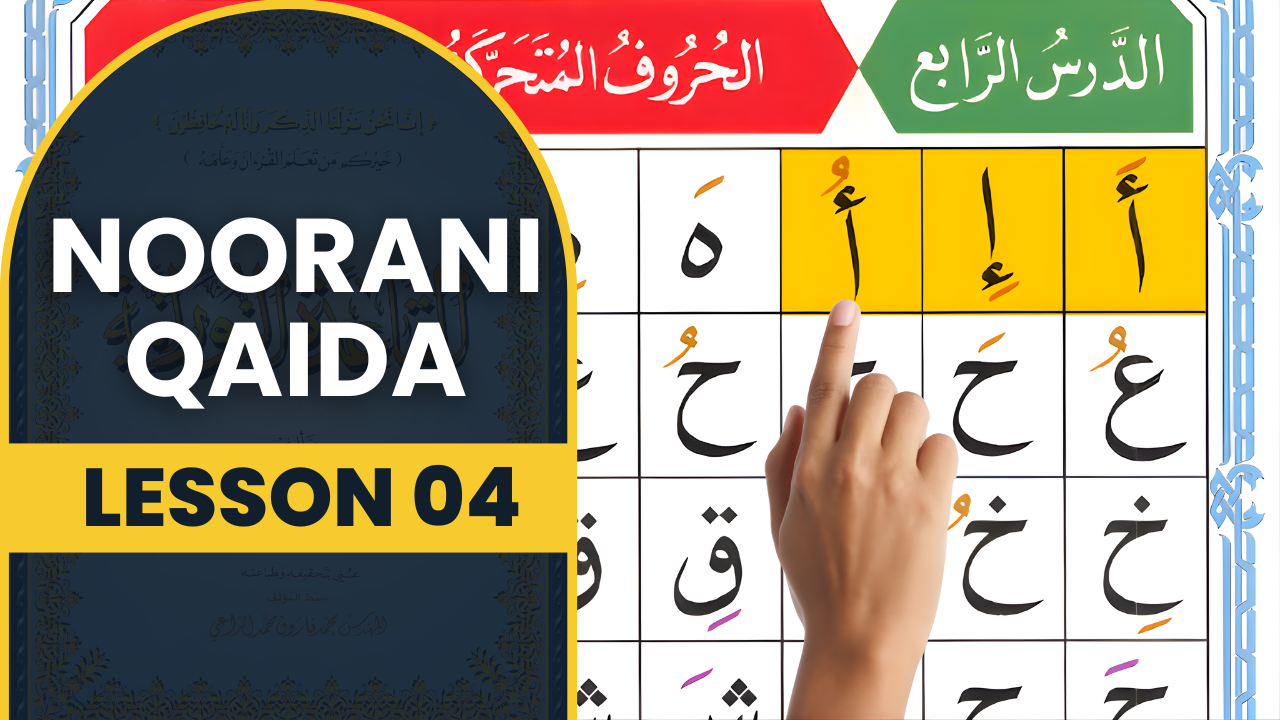
Noorani Qaida Lesson 4 introduces three short vowel marks:
- Fatha ( ـَ )
- Kasra ( ـِ )
- Damma ( ـُ )
These are called Harakat (movements), and they change how a letter sounds.
For example:
- بَ = Ba
- بِ = Bi
- بُ = Bu
With Harakat, learners move from recognizing letters to producing full syllables.
Lesson Overview
Book: Noorani Qaida
Lesson Number: 4
Topic: Harakat (Fatha, Kasra, Damma)
Language: English-guided Arabic
Version: 02 – for Non-Arabic Learners
Teacher: Qari Rafiqul Islam
Student: Sumaiya Islam
Learning Level: Beginner
Target Group: Children, new Muslims, and non-Arabic speakers
Understanding Harakat (Short Vowel Marks)
Arabic letters alone represent consonant sounds. Harakat add short vowels to these letters.
There are three primary short vowels:
1️⃣ Fatha ( ـَ )
A small line placed above the letter.
Sound: a short Arabic a sound. English “cat” is only an approximation; copy the teacher’s Arabic pronunciation. Example: بَ (ba).
Fatha opens the mouth slightly and produces a light “a” sound.
2️⃣ Kasra ( ـِ )
A small line placed below the letter.
Sound: “i” as in “sit”
Example: بِ (Bi)
Kasra produces a short “i” sound from the front of the mouth.
3️⃣ Damma ( ـُ )
A small curl placed above the letter.
Sound: “u” as in “put”
Example: بُ (Bu)
Damma rounds the lips and produces a short “u” sound.
Why Harakat Are Essential for Quran Reading
Without Harakat, Arabic text cannot be pronounced accurately.
Consider the letter ب:
Without vowels, it is just “b.”
With Harakat:
- بَ = Ba
- بِ = Bi
- بُ = Bu
Each change alters pronunciation and meaning in words.
Learning Harakat is the first step toward reading complete Quranic words.
Step-by-Step Learning Focus
Pronouncing Syllables Clearly
Lesson 4 trains learners to combine consonants and vowels smoothly.
Students practice:
Ba, Bi, Bu
Ta, Ti, Tu
Sa, Si, Su
This repetition builds reading rhythm.
Understanding Mouth Position
Each Harakah requires slight mouth adjustment:
- Fatha → Open mouth slightly
- Kasra → Relax mouth
- Damma → Round lips
This physical awareness improves clarity.
Avoiding Common Pronunciation Mistakes
Beginners often:
- Stretch short vowels too long
- Confuse “i” and “e” sounds
- Mispronounce Damma without rounding lips
Lesson 4 corrects these habits early.
Teaching Approach at Rasool Academy
Our structured method ensures clarity:
- Slow demonstration of each vowel
- Clear on-screen examples
- Guided repetition
- English pronunciation support
- Progressive reading exercises
This calm approach prevents confusion and builds confidence.
The Transition from Letters to Words
Lesson 4 is the bridge between recognizing letters and reading actual words.
For example:
بَ + تَ = بَتَ
Students begin seeing how syllables form small word patterns.
This prepares learners for Tanween in Lesson 5 and combined vowel practice in Lesson 6. Sukoon is introduced in Lesson 10.
Common Difficulties in Learning Harakat
Mixing Short and Long Sounds
Learners sometimes extend Fatha too long.
Solution: Keep the vowel short and crisp.
Confusing Kasra with English “ee”
Kasra is short, not long.
Solution: Say “Bi,” not “Bee.”
Forgetting Lip Rounding for Damma
Solution: Practice in front of a mirror.
Practical Study Tips
- Practice 10 minutes daily
- Repeat each syllable 5–10 times
- Focus on short sound accuracy
- Review previous lessons before adding new vowels
- Avoid rushing into Tanween until comfortable
Short, consistent practice leads to fluency.
Spiritual Reflection
The Qur’an was revealed with precise pronunciation. Even a small vowel change can alter meaning.
Allah says:
“And recite the Qur’an with measured recitation.” (Qur’an 73:4)
Harakat help us fulfill this command by ensuring accuracy and clarity.
Each correctly pronounced syllable brings reward.
Summary of Key Points
- Harakat are short vowel marks.
- There are three: Fatha, Kasra, Damma.
- They transform letters into pronounceable syllables.
- Correct mouth positioning improves clarity.
- Mastery prepares students for Tanween and Sukoon.

Continue Learning – Complete Noorani Qaida Course
Follow the lessons step by step for best results.
Frequently Asked Questions
1. What are Harakat in Arabic?
They are short vowel marks that determine how letters are pronounced.
2. How many Harakat are there?
Three primary short vowels: Fatha, Kasra, and Damma.
3. Why are Harakat important in Quran reading?
They ensure correct pronunciation and preserve meaning.
4. Is Lesson 4 difficult?
No. With daily practice, learners adapt quickly.
5. What comes after Harakat?
Lesson 5 introduces Tanween (double vowels).
Conclusion
Noorani Qaida Lesson 4 is the true beginning of reading Arabic fluently. By mastering Fatha, Kasra, and Damma, learners move from recognizing letters to producing accurate syllables.
With patience, repetition, and sincerity, anyone can begin reading the Qur’an correctly.
May Allah make your learning journey easy and blessed.