Noorani Qaida Lesson 10 | How to Read Sukoon in Arabic with Tajweed
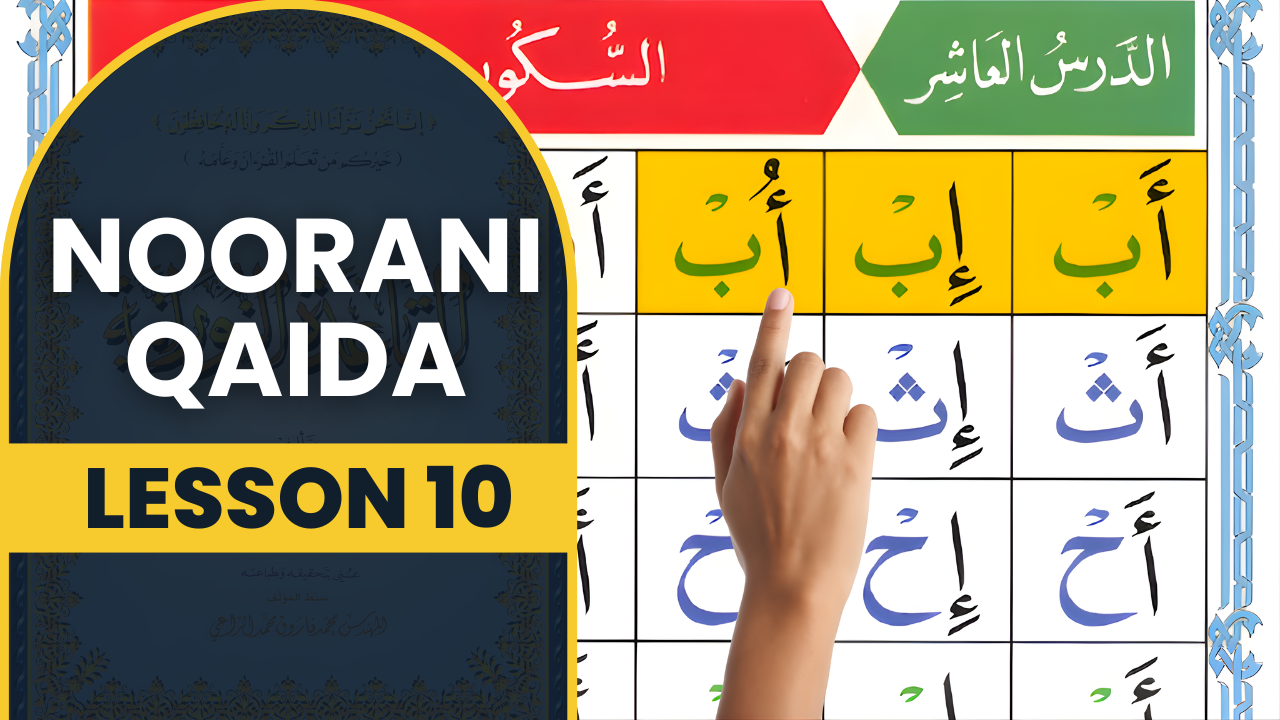
Noorani Qaida Lesson 10 introduces Sukoon — one of the most important pronunciation elements in Quran reading. After mastering Harakat, Tanween, Madd letters, and Leen letters, learners are now ready to understand how unvowelled letters function within Arabic words.
Sukoon ( ْ ) indicates the absence of a vowel sound. A letter with Sukoon is pronounced clearly but without any vowel after it. This creates a stop or closure in sound.
For beginners and non-Arabic speakers, Sukoon can be challenging. It requires precision, breath control, and articulation discipline.
At Rasool Academy, we teach Sukoon step by step so that learners develop clarity and confidence before moving to advanced Tajweed combinations.
🎥 Watch Noorani Qaida Lesson 10 – Sukoon Pronunciation Practice
Follow carefully and practice stopping clearly on each Sukoon letter.
What Is Sukoon in Arabic?
Sukoon is a small circle placed above a letter:
Example:
بْ
It means the letter is pronounced without Fatha, Kasra, or Damma.
Unlike Harakat (which create movement), Sukoon creates stillness.
Pronounce the consonant without a following short vowel; Sukoon alone does not require a pause.
Lesson Overview
Book: Noorani Qaida
Lesson Number: 10
Topic: Sukoon Pronunciation in Words
Language: English-guided Arabic
Version: 02 – for Non-Arabic Learners
Teacher: Qari Rafiqul Islam
Learning Level: Beginner to Intermediate
Target Group: Children, adults, and new Muslims
Difference Between Harakat and Sukoon
Harakat create movement:
بَ – Ba
بِ – Bi
بُ – Bu
Sukoon creates closure:
بْ – “B” (without vowel)
In Sukoon, the sound ends immediately.
There is no elongation.
There is no nasal tone.
There is no additional vowel.
How to Pronounce Sukoon Correctly
When a letter carries Sukoon:
- Pronounce the consonant clearly.
- Complete the consonant without adding a vowel, and move smoothly to the next sound.
- Do not add any vowel after it.
Example:
أَبْ
The “B” must be clear but without “ba” or “bu.”
This requires tongue control and airflow discipline.
Sukoon Inside Words
Sukoon often appears in the middle of words.
Example patterns:
يَكْتُبُ
مِنْهُمْ
يَدْخُلُ
Here, Sukoon creates consonant clusters.
Learners must avoid inserting hidden vowels.
Common mistake:
Saying “yakutubu” instead of “yaktubu.”
Correction:
Pronounce the consonant firmly and move directly to the next letter.
Phonetic Mechanics of Sukoon
Sukoon requires:
- Strong articulation
- Controlled airflow
- Immediate transition
- No vowel extension
It builds consonant strength in pronunciation.
Without Sukoon mastery, recitation becomes weak and unclear.
Types of Letters with Sukoon
Some letters are easy with Sukoon. Others require more control.
Easy Sukoon Letters:
مْ
نْ
لْ
Challenging Sukoon Letters:
قْ
طْ
بْ
دْ
Some of these letters may also involve Qalqalah when stopping.
Lesson 10 focuses on clear Sukoon pronunciation before Qalqalah variations are studied deeply.
Sukoon vs Madd – Important Contrast
Madd = elongation.
Sukoon = closure.
Example contrast:
قَالَ → Long vowel
قَلْ → Stop on Lam
Confusing these changes rhythm and meaning.
Lesson 10 trains clear differentiation.
Common Mistakes in Sukoon Pronunciation
❌ Adding hidden vowel after Sukoon
❌ Weak articulation
❌ Rushing consonant cluster
❌ Overemphasizing stop
❌ Confusing Sukoon with Tanween
Correction method:
Slow repetition.
Clear consonant articulation.
Immediate transition.
Structured Practice in Lesson 10
Lesson 10 includes:
- Single letter Sukoon drills
- Two-letter cluster drills
- Word-level Sukoon practice
- Gradual speed increase
Repetition builds clarity and confidence.
Why Sukoon Is Essential in Quran Reading
Sukoon preserves:
- Correct word structure
- Accurate consonant sounds
- Proper rhythm
- Clear articulation
Without proper Sukoon, words may sound distorted.
Mastering Sukoon strengthens Tajweed foundation.
Breath Control and Sukoon
Sukoon requires:
- Strong but controlled airflow
- Smooth connection of unvowelled consonants
- Smooth transition to next letter
Students must avoid tension or forced stopping.
Breath should remain steady.
How Lesson 10 Prepares for Shaddah
Shaddah contains an internal Sukoon.
Understanding Sukoon clearly prepares learners for double consonants in later lessons.
If Sukoon is weak, Shaddah becomes difficult.
Lesson 10 lays the groundwork.
Study Plan for Lesson 10
Day 1–2: Practice single-letter Sukoon
Day 3–4: Practice cluster patterns
Day 5–6: Practice Sukoon inside words
Day 7: Mixed reading drills
Practice 15 minutes daily for strong results.
Teaching Approach at Rasool Academy
We focus on:
- Clear articulation training
- Slow consonant emphasis
- Visual demonstration
- Gradual integration into words
- Calm repetition
This prevents early pronunciation habits from becoming permanent mistakes.

Spiritual Reflection
The Qur’an is revealed with precision and balance.
Every Sukoon letter represents stillness within movement.
Pronouncing Sukoon correctly reflects discipline and reverence for divine speech.
Each clear consonant earns reward.
Continue Learning – Complete Noorani Qaida Course
Frequently Asked Questions
What does Sukoon mean?
It means the absence of a vowel on a letter.
Is Sukoon difficult?
It requires practice but becomes natural with repetition.
Should I add a small vowel after Sukoon?
No. The letter must end without a vowel.
How long should I practice daily?
15 minutes of focused repetition is ideal.
What comes after Lesson 10?
Lesson 11 introduces advanced Sukoon combinations and fluency practice.
Key Takeaways
- Sukoon means no vowel.
- The consonant must be pronounced clearly without adding a vowel; continue smoothly unless making a valid stop.
- Do not add hidden vowels.
- Sukoon builds consonant strength.
- Mastery prepares for Shaddah and advanced Tajweed.
Conclusion
Noorani Qaida Lesson 10 introduces Sukoon pronunciation and strengthens consonant control in Quran reading. By mastering Sukoon, learners build clarity, rhythm stability, and Tajweed discipline.
With consistent practice, Sukoon becomes natural and reading becomes confident.
May Allah grant precision and reward in learning His Book.
Sukoon is not a pause sign
Sukoon means that a consonant has no following short vowel; it does not make the consonant silent and does not set a fixed pause or half-beat duration. Continue naturally through a word. Give each letter its own characteristics, including Qalqalah for sakin ق ط ب ج د. Choose actual pauses according to Waqf and meaning, and ask the teacher to check your recitation.