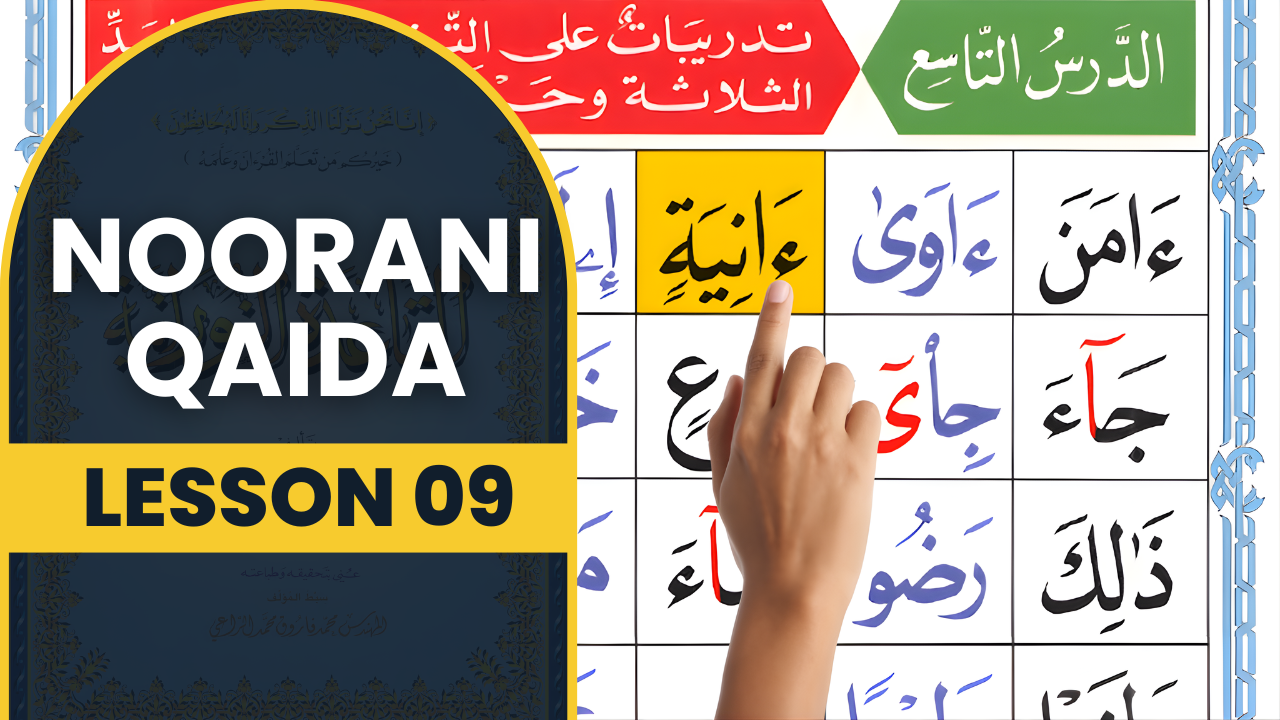
Noorani Qaida Lesson 9 | Practice Tanween & Madd with Tajweed
Noorani Qaida Lesson 9 marks an important transition from isolated rule practice to real word application. After learning Tanween (double vowels), Madd letters (long vowels), and Leen letters (soft glide sounds), learners now begin applying these rules within structured Quranic-style words.
This lesson is not about introducing new Tajweed rules. Instead, it strengthens the learner’s ability to recognize and apply previously learned rules smoothly inside complete words.
For beginners and non-Arabic learners, this stage is crucial. Reading individual patterns is easier than reading integrated words. Lesson 9 builds the bridge between controlled drills and actual Quran reading.
At Rasool Academy, we guide students step by step so that pronunciation remains accurate, rhythm remains stable, and confidence grows naturally.
🎥 Watch Noorani Qaida Lesson 9 – Tanween, Madd & Leen Practice
Follow carefully and repeat each word slowly before increasing speed.
What Is Noorani Qaida Lesson 9 About?
Lesson 9 focuses on:
- Practicing Tanween inside words
- Identifying Madd letters in real reading
- Recognizing Leen sounds correctly
- Coordinating multiple rules together
- Developing reading rhythm
This is the first stage where students experience rule interaction.
Lesson Overview
Book: Noorani Qaida
Lesson Number: 9
Topic: Combined Practice – Tanween, Madd Letters & Leen Letters
Language: English-guided Arabic
Version: 02 – for Non-Arabic Learners
Teacher: Qari Rafiqul Islam
Learning Level: Beginner to Early Intermediate
Target Group: Children, adults, and new Muslims
Review: Tanween in Words
Tanween produces a soft nasal ending:
- Fathatain (ً)
- Kasratain (ٍ)
- Dammatain (ٌ)
In Lesson 9, Tanween appears at the end of structured words.
Example:
كِتَابًا
عَلِيمٌ
حَكِيمٍ
Important reminder:
Tanween must be soft and controlled.
It must not turn into long Madd.
It must not disappear completely.
Review: Madd Letters in Words
Madd letters extend vowel sounds for two counts:
- Fatha + Alif
- Damma + Waw
- Kasra + Ya
Example inside words:
قَالَ
يَقُولُ
قِيلَ
In Lesson 9, learners must recognize Madd quickly within a word and stretch it correctly without overextending.
Review: Leen Letters in Words
Leen occurs when:
- Waw or Ya
- Has Sukoon
- Is preceded by Fatha
Examples:
خَوْف
بَيْت
Leen produces a soft glide, not full elongation.
Lesson 9 trains learners to distinguish Leen from Madd when both appear in the same reading exercise.
The Core Objective of Lesson 9
Lesson 9 trains the learner to:
- Identify rule type instantly
- Apply the rule correctly
- Maintain smooth reading
- Avoid hesitation
This develops reading reflexes.
Instead of thinking:
“Is this Madd or Leen?”
The student begins to recognize patterns naturally.
Rule Interaction: How Tanween, Madd, and Leen Work Together
Lesson 9 includes words that combine multiple elements.
Example structure:
Word containing Madd + Tanween
Word containing Leen + Tanween
Word containing Madd + Leen
Students must:
- Stretch Madd properly
- Glide Leen softly
- Add nasal tone for Tanween
All within one continuous reading flow.
This builds advanced coordination.
Deep Fluency Development in Lesson 9
1️⃣ Recognition Speed
Students learn to scan words quickly and identify:
- Long vowels
- Nasal endings
- Soft glide sounds
This improves reading confidence.
2️⃣ Rhythm Stability
When multiple rules appear in one word, rhythm often breaks.
Lesson 9 trains consistent pacing:
- Madd → 2 counts
- Leen → soft glide
- Tanween → light nasal
Balanced timing prevents uneven recitation.
3️⃣ Breath Control
Integrated reading requires controlled breathing.
Students learn to:
- Maintain steady airflow
- Avoid gasping between sounds
- Preserve smooth transitions
This prepares them for longer Quranic passages.
Common Mistakes in Lesson 9
❌ Turning Tanween into Madd
❌ Overstretching Leen
❌ Ignoring Madd
❌ Rushing through integrated words
❌ Losing rhythm
Correction method:
Slow down.
Identify each rule clearly.
Apply timing discipline.
Practical Study Plan
Day 1–2: Focus on Tanween in words
Day 3–4: Focus on Madd recognition
Day 5–6: Focus on Leen differentiation
Day 7: Combined reading drills
Repeat daily for 15 minutes.
Consistency builds natural flow.
Why Lesson 9 Is a Turning Point
Before Lesson 9:
Students practice rules in isolation.
After Lesson 9:
Students begin reading rule combinations naturally.
This lesson builds:
- Confidence
- Rule awareness
- Pronunciation coordination
- Tajweed readiness
It prepares students for Sukoon clusters and Shaddah integration in later lessons.
How Lesson 9 Prepares for Advanced Tajweed
After mastering this lesson, learners are ready for:
- Sukoon in complex words
- Shaddah application
- Combined Madd variations
- Full Quranic verse practice
Lesson 9 strengthens the base before complexity increases.
Teaching Method at Rasool Academy
We follow a structured approach:
- Clear identification of rule inside each word
- Slow pronunciation
- Count-based elongation
- Nasal control training
- Guided repetition
This ensures learners apply rules confidently.

Spiritual Reflection
The Qur’an is recited with balance and precision. Integrated rules create rhythm and beauty in recitation.
When Tanween, Madd, and Leen are applied correctly, recitation flows smoothly and meaning remains preserved.
Each correctly pronounced word strengthens connection with Allah’s Book.
Continue Learning – Complete Noorani Qaida Course
Frequently Asked Questions
Is Lesson 9 introducing new rules?
No. It combines previously learned rules.
Why is this lesson harder than previous ones?
Because multiple rules appear in one word.
How long should I practice daily?
15 minutes of focused repetition is ideal.
What should I focus on most?
Rule identification and timing discipline.
What comes after Lesson 9?
Lesson 10 introduces structured Sukoon practice in words.
Key Takeaways
- Lesson 9 integrates Tanween, Madd, and Leen.
- Recognition speed improves fluency.
- Madd lasts two counts.
- Leen is soft and shorter.
- Tanween carries nasal sound.
- Rule coordination builds Tajweed readiness.
Conclusion
Noorani Qaida Lesson 9 is a major fluency-building stage. By practicing Tanween, Madd letters, and Leen letters inside Quranic-style words, learners develop coordination, rhythm, and pronunciation confidence.
With steady practice, rule interaction becomes natural and reading becomes smooth.
May Allah grant clarity and reward in learning His Book.