Noorani Qaida Lesson 8 | Learn Madd & Leen Letters with Tajweed
Noorani Qaida Lesson 8 introduces two essential pronunciation principles in Quran reading: Madd letters and Leen letters. After mastering Standing Fatha, Kasra, and Damma in Lesson 7, learners are now ready to understand how elongation works in different contexts and how soft glide sounds differ from full elongation.
This lesson strengthens vocal control, timing awareness, and articulation precision — all of which are foundational for accurate Tajweed.
For non-Arabic learners, distinguishing between Madd and Leen is extremely important. Although both involve extended sounds, their pronunciation rules and timing differ.
At Rasool Academy, we teach Madd and Leen slowly, clearly, and systematically so that learners develop rhythm and clarity before progressing to advanced Tajweed rules.
🎥 Watch the Noorani Qaida Lesson 8 – Learn Letters of Madd & Leen
Follow carefully and repeat each example with proper elongation and softness.
What Are Madd Letters?
Madd means “to stretch” or “to lengthen.” In Quran reading, Madd letters extend vowel sounds for a measured duration.
There are three Madd letters:
- Alif (ا)
- Waw (و)
- Ya (ي)
These letters create long vowel sounds when preceded by matching short vowels:
- Fatha + Alif → “aa”
- Damma + Waw → “oo”
- Kasra + Ya → “ee”
This type of elongation is known as natural elongation and lasts two counts.
Lesson Overview
Book: Noorani Qaida
Lesson Number: 8
Topic: Madd Letters and Leen Letters
Language: English-guided Arabic
Version: 02 – for Non-Arabic Learners
Teacher: Qari Rafiqul Islam
Learning Level: Beginner to Early Intermediate
Target Group: Children, new Muslims, and non-Arabic speakers
Understanding Madd in Detail
Madd letters must:
- Be preceded by the correct short vowel
- Be pronounced with two counts
- Maintain steady airflow
- Avoid nasal sound
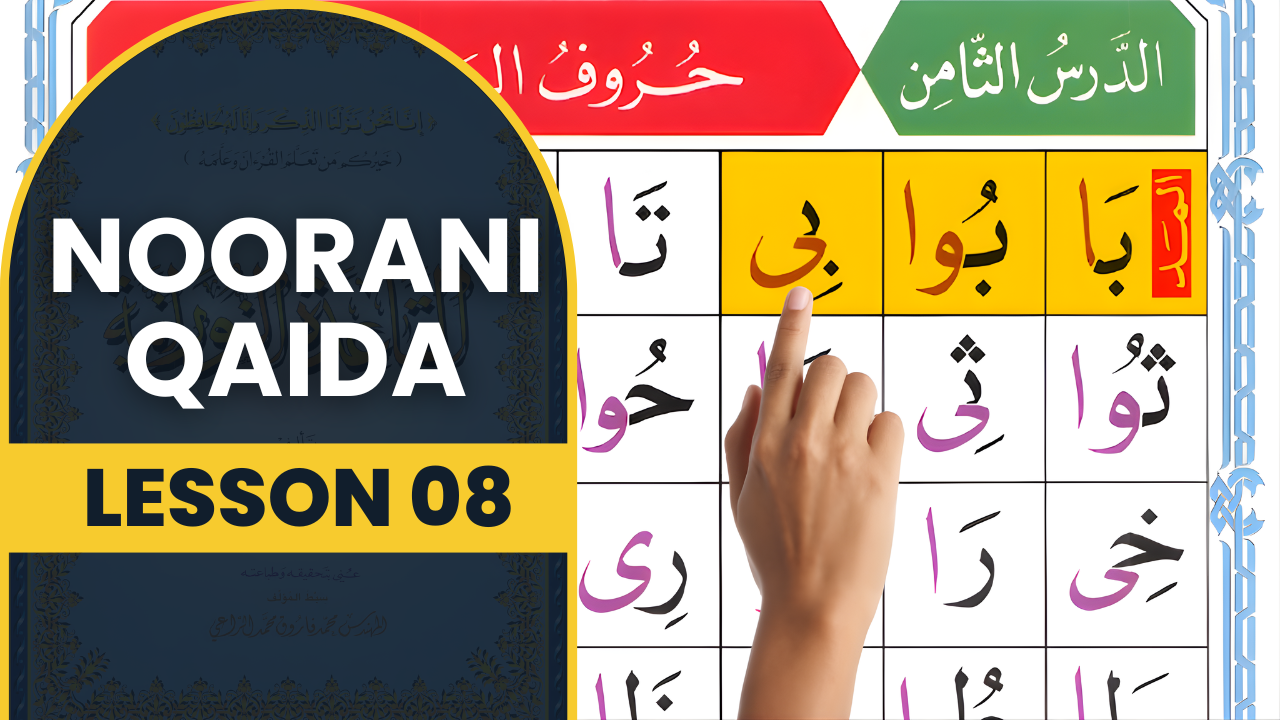
Example of Madd with Alif
بَا → Baa
Open the mouth slightly and extend the sound evenly.
Example of Madd with Waw
بُو → Boo
Round the lips clearly and maintain airflow.
Example of Madd with Ya
بِي → Bee
Stretch the “ee” sound clearly without tension.
Common Mistakes in Madd
- Overstretching beyond two counts
- Turning Madd into shouting
- Weak elongation
- Adding nasal tone (incorrect)
Correction method:
Count silently — One… Two…
Maintain stable pitch and airflow.
What Are Leen Letters?
Leen means “softness.” Leen letters produce a soft glide sound rather than full elongation.
Leen occurs when:
- Waw (و) or Ya (ي)
- Is preceded by Fatha
- And carries Sukoon
Example:
خَوْف
بَيْت
These sounds are soft and glide smoothly. They are not stretched like Madd.
Difference Between Madd and Leen
This is the most important concept in Lesson 8.
Madd:
- Full elongation
- Two counts
- Strong and stable sound
Leen:
- Soft glide
- Shorter than Madd
- Gentle transition
Many beginners confuse Leen with Madd. Lesson 8 trains the ear to recognize the difference.
Phonetic Mechanics of Leen
Leen requires:
- Relaxed articulation
- Smooth airflow
- No forceful stretching
For example:
خَوْف
The “aw” sound glides softly.
It should not be extended like a long “oo.”
Why Lesson 8 Is Important
Lesson 8 strengthens:
- Timing control
- Sound differentiation
- Rhythm stability
- Vocal flexibility
Without understanding the difference between Madd and Leen, students may:
- Overstretch soft sounds
- Flatten elongated vowels
- Distort Quranic rhythm
Structured Practice in Lesson 8
Practice is divided into:
1️⃣ Madd with Alif drills
2️⃣ Madd with Waw drills
3️⃣ Madd with Ya drills
4️⃣ Leen with Waw examples
5️⃣ Leen with Ya examples
6️⃣ Mixed comparison drills
This comparison training builds auditory awareness.
Advanced Preparation Through Lesson 8
Lesson 8 prepares students for advanced elongation rules such as:
- Madd Asli (Natural Madd)
- Madd Muttasil (Connected Madd)
- Madd Munfasil (Separated Madd)
- Madd Lazim (Required Madd)
It also strengthens Sukoon control and prepares for Shaddah interactions.
Common Difficulties in Lesson 8
❌ Confusing Leen with Madd
❌ Overstretching Leen sounds
❌ Weak Madd elongation
❌ Inconsistent count timing
❌ Rushing through examples
Correction:
Practice slowly.
Focus on contrast.
Use count-based discipline.
Study Plan for Lesson 8
Day 1–2: Madd with Alif
Day 3–4: Madd with Waw
Day 5–6: Madd with Ya
Day 7: Leen comparison drills
Consistency builds automatic rhythm.
Teaching Method at Rasool Academy
Our structured method includes:
- Visual vowel pairing explanation
- Count-based elongation training
- Soft glide demonstration
- Guided repetition
- Calm, distraction-free recitation
This ensures clarity and prevents long-term pronunciation errors.

Spiritual Reflection
The Qur’an is revealed with measured recitation. Elongation and softness are part of its beauty.
Proper Madd preserves rhythm.
Correct Leen maintains softness.
Reciting with precision reflects respect for divine speech.
Every correctly elongated vowel is an act of obedience.
Continue Learning – Complete Noorani Qaida Course
Frequently Asked Questions
What is the difference between Madd and Leen?
Madd is full elongation (two counts).
Leen is a soft glide sound.
How long should Madd last?
Two counts in basic practice.
Does Leen require two counts?
No. It is softer and shorter.
Are Madd and Leen difficult?
No, when practiced slowly and systematically.
What comes after Lesson 8?
Lesson 9 introduces combined practice with Madd, Tanween, and Leen.
Key Takeaways
- Madd letters: Alif, Waw, Ya
- Madd lasts two counts
- Leen occurs with Waw or Ya after Fatha and Sukoon
- In connected reading Leen is a natural aw/ay glide; stopping may introduce Madd Leen.
- Differentiation builds Tajweed accuracy
Conclusion
Noorani Qaida Lesson 8 teaches Madd and Leen letters with clarity and precision. By mastering elongation and softness, learners build rhythm, control, and Tajweed awareness.
With steady practice, recitation becomes balanced and beautiful.
May Allah beautify your recitation and reward every effort in learning His Book.