Noorani Qaida Lesson 2 | Learn Arabic Joining Letters with Tajweed
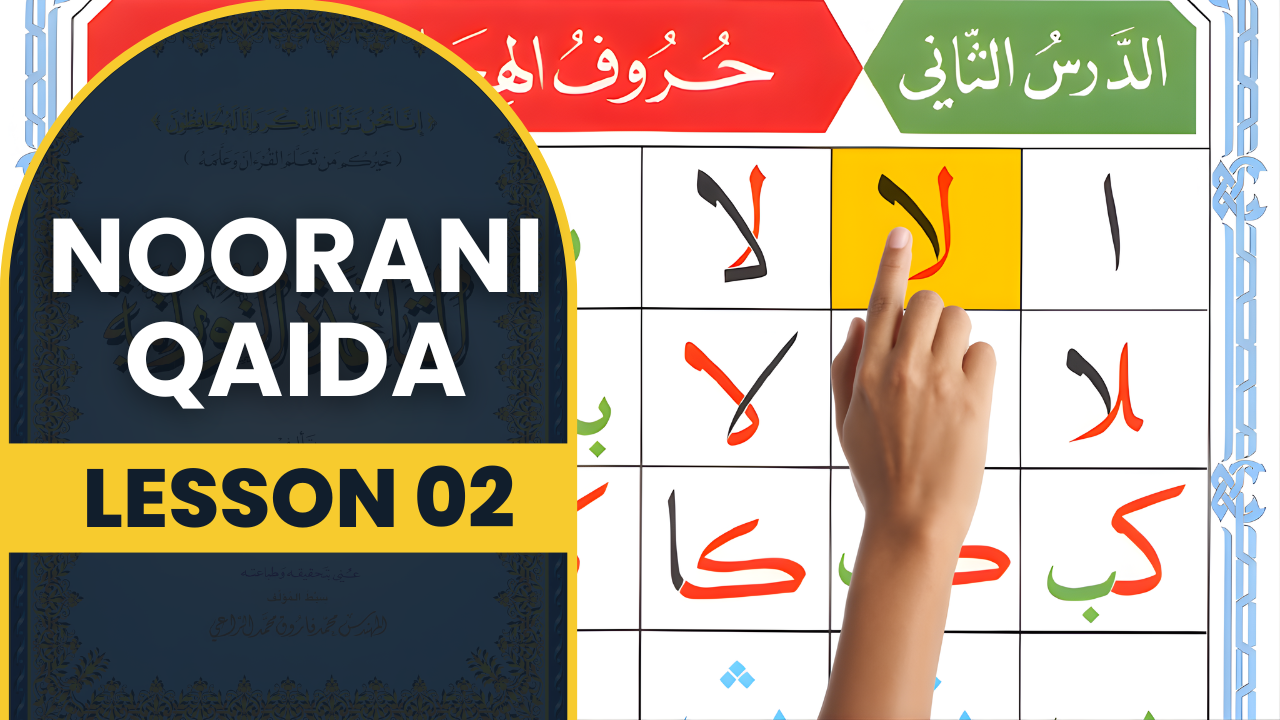
Noorani Qaida Lesson 2 is the second foundational step in learning to read the Holy Qur’an correctly. After mastering the individual Arabic letters in Lesson 1, this lesson introduces Arabic Joining Letters (Huruf Murakkabah) — teaching learners how Arabic letters connect and change shape inside words.
Arabic is a connected script. Unlike English, where letters remain separate, Arabic letters join together, and their shapes transform depending on their position. Understanding this transformation is essential before learning vowel marks (Harakat) and Tajweed rules.
At Rasool Academy, we guide students step by step, ensuring that beginners—especially non-Arabic speakers—develop confidence in reading connected Arabic letters smoothly and correctly. This lesson removes hesitation and prepares learners for real Quranic words.
In this English-guided Version 02 of the Noorani Qaida course, learners receive visual cues, pronunciation guidance, and structured repetition to make understanding connected letters simple and clear.
🎥 Watch the Noorani Qaida Lesson 2 – Arabic Connecting Letters
You can watch the complete Lesson 2 video on the Rasool Academy YouTube channel to follow along with the pronunciation, shape transformations, and guided repetition.
What This Lesson Covers
Noorani Qaida Lesson 2 focuses on how Arabic letters connect and appear in different positions. The lesson covers:
- Understanding Huruf Murakkabah (joint letters)
- Learning the four positional forms of Arabic letters
- Recognizing which letters connect on both sides
- Identifying letters that do not connect to the left
- Reading simple connected combinations
- Building visual recognition and fluency
By mastering these elements, learners gain the structural foundation needed to read Arabic words confidently.
Lesson Overview
Book: Noorani Qaida
Lesson Number: 2
Topic: Huruf Murakkabah (Joint Letters)
Language: English-guided Arabic
Version: 02 – for Non-Arabic Learners
Teacher: Qari Rafiqul Islam
Student: Sumaiya Islam
Learning Level: Beginner
Target Group: Children, new Muslims, and non-Arabic speakers
Step-by-Step Learning Focus
Understanding Huruf Murakkabah (Joint Letters)
Huruf Murakkabah means “combined letters.” In Arabic writing, most letters connect to the letters before and after them. When they connect, their shapes change slightly.
For example, the letter Ba (ب) looks different when it appears:
- Alone (isolated form)
- At the beginning of a word
- In the middle of a word
- At the end of a word
Lesson 2 trains learners to recognize these variations quickly and confidently.
The Four Forms of Arabic Letters
Each Arabic letter can appear in four possible forms:
- Isolated Form – The letter written alone.
- Initial Form – When the letter appears at the beginning of a word.
- Medial Form – When the letter appears in the middle and connects from both sides.
- Final Form – When the letter appears at the end of a word.
Understanding these forms eliminates confusion when reading longer Arabic words.
Letters That Connect on Both Sides
Most Arabic letters connect from both sides. These letters smoothly join with the next letter.
Examples include:
ب ، ت ، ث ، ج ، ح ، خ ، س ، ش ، ص ، ض ، ف ، ق ، ك ، ل ، م ، ن ، ه ، ي
Recognizing these letters helps students read without breaking the flow of a word.
Letters That Do Not Connect to the Left
Some Arabic letters connect only from the right side and do not connect to the letter after them. These letters are:
ا ، د ، ذ ، ر ، ز ، و
This rule is extremely important. If learners try to connect these letters incorrectly, the word’s structure becomes confusing.
Lesson 2 emphasizes these special letters to prevent mistakes in future reading.
Visual Recognition and Shape Awareness
Many Arabic letters look similar but differ in dot placement.
For example:
- ب ، ت ، ث
- ج ، ح ، خ
- س ، ش
When connected, their shapes may look even more alike. That is why Lesson 2 strengthens visual focus and careful observation.
Learners are trained to:
- Count dots carefully
- Observe connection lines
- Compare isolated and connected forms
- Practice slowly until shapes feel familiar
This visual discipline builds long-term fluency.
Teaching Approach at Rasool Academy
Rasool Academy uses a calm and structured method for teaching joint letters:
Slow Recitation – Each connected form is pronounced clearly.
Visual Demonstration – Large, clear letter forms are displayed on screen.
Step-by-Step Progression – Simple combinations first, then slightly longer ones.
Repetition-Based Learning – Students repeat after the teacher multiple times.
Peaceful Environment – No background music, ensuring spiritual focus.
This approach builds clarity, not confusion.
Why Mastering Joint Letters Is Essential
Without understanding connected letters:
- Students hesitate while reading
- Words appear complicated
- Tajweed rules become harder to apply
- Confidence decreases
Huruf Murakkabah is the bridge between knowing letters and reading Quranic words fluently.
Lesson 2 prepares learners for:
- Harakat (Fatha, Kasra, Damma)
- Tanween (double vowels)
- Sukoon (unvowelled letters)
- Shaddah (double sound letters)
A strong foundation here makes every future lesson easier.
Who Can Learn from This Lesson
Lesson 2 is ideal for:
- Children progressing from Lesson 1
- Adults starting Quran reading
- New Muslims learning Arabic
- Parents teaching at home
- Non-Arabic speakers who need structured guidance
This lesson removes fear and builds reading confidence gradually.
Practical Study Tips
To master Lesson 2 effectively:
- Practice 10–15 minutes daily
- Focus on shape changes carefully
- Review the six non-connecting letters regularly
- Read connected examples slowly
- Avoid rushing into vowel lessons before mastering shapes
Consistency builds reading confidence.
Common Difficulties and How to Overcome Them
Confusing Similar Shapes
Solution: Compare letters side by side.
Over-Connecting Letters
Solution: Memorize the six non-connecting letters carefully.
Reading Too Fast
Solution: Slow down and prioritize clarity over speed.
Hesitation
Solution: Repetition removes fear.
Spiritual Reflection
Learning connected Arabic letters is more than a reading skill—it is preparation for understanding the words of Allah.
Allah says:
“Indeed, We have sent it down as an Arabic Qur’an so that you may understand.” (Qur’an 12:2)
Every correctly read letter is an act of worship. The Prophet (peace be upon him) said that every letter of the Qur’an carries reward.
When learners carefully pronounce connected letters, they preserve the beauty and meaning of divine revelation.
Summary of Key Points
- Huruf Murakkabah means joint Arabic letters.
- Arabic letters change shape based on position.
- There are letters that do not connect to the left.
- Visual awareness prevents confusion.
- Mastery of Lesson 2 prepares students for Harakat and Tajweed.

Continue Learning – Complete Noorani Qaida Course
Follow the lessons in order for steady progress.
Frequently Asked Questions
1. What is Huruf Murakkabah?
It refers to Arabic letters when they are joined together in words.
2. Is Lesson 2 difficult?
No. With slow practice and repetition, learners become comfortable quickly.
3. How long should I practice daily?
10–15 minutes daily is sufficient for steady improvement.
4. What comes after Lesson 2?
Lesson 3 introduces Huroof Muqatta’at, followed by vowel rules.
5. Can children understand connected letters easily?
Yes. With visual guidance and repetition, children adapt naturally.
Conclusion
Noorani Qaida Lesson 2 transforms isolated letter knowledge into connected reading ability. By mastering Huruf Murakkabah, learners remove hesitation and prepare themselves for fluent Quran recitation.
Take your time. Practice with patience. Build your foundation carefully.
May Allah make your Quran learning journey easy, rewarding, and full of light.