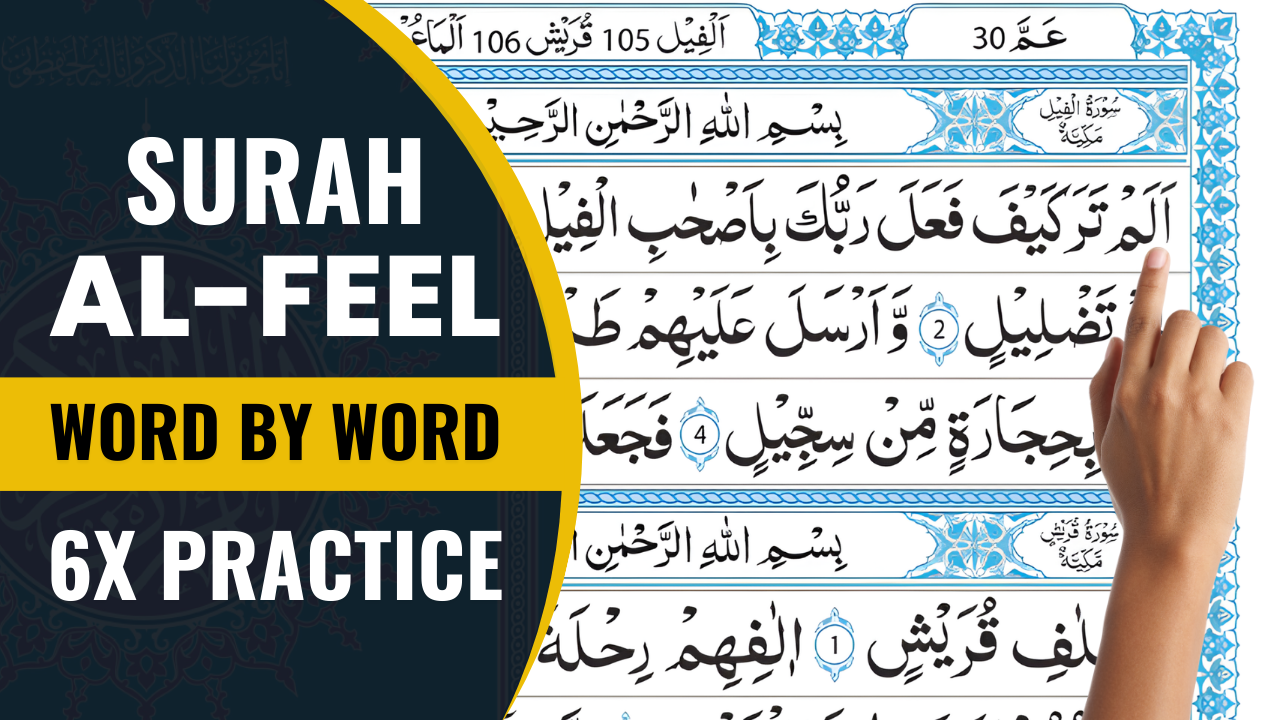
Memorize Surah Al-Fil Word by Word with Tajweed | 3X Practice
Surah Al-Fil is a short but powerful chapter of the Qur’an that reminds us of Allah’s protection and supreme power. Though it consists of only five verses, it contains multiple Tajweed rules that require careful pronunciation. Many people memorize this Surah early in life, but memorization without proper Tajweed can lead to long-term pronunciation mistakes.
How to use this practice guide: 3X means three suggested practice rounds for you. Use the recording below as a pronunciation model, then pause or replay it to complete your rounds. This is a study plan, not a count of the repetitions inside the recording; the video player may show a different repetition label.
The 3X practice method is designed to help you memorize Surah Al-Fil word by word with Tajweed while strengthening accuracy, fluency, and confidence. Instead of repeating the Surah quickly, this structured system builds correct articulation step by step.
Progress depends on reading ability, practice and feedback. Review regularly and ask a qualified teacher to check your recitation; there is no guaranteed completion time.
Watch Surah Al-Fil Word by Word (Guided Practice)
How the 3X system works:
- Round 1: Listen carefully and repeat the words with the teacher.
- Round 2: Connect the words into a complete verse while checking pronunciation.
- Round 3: Recite from memory, then check against the recording and correct mistakes.
Repetition with structure builds mastery.
Why Use the 3X Memorization Method?
Most people memorize short Surahs by repeating them quickly. The 3X method improves memorization because it:
- Corrects Makharij (articulation points) early
- Reinforces Madd timing
- Strengthens Shaddah clarity
- Develops heavy letter pronunciation
- Builds long-term retention
Use the three rounds as a starting plan. Repeat and revise for as long as needed; a fixed number of repetitions does not guarantee memorization.
Overview of Surah Al-Fil
Surah Al-Fil consists of 5 verses and describes the event of the army of the elephant. From a Tajweed perspective, it contains:
- Madd (elongation)
- Heavy letters: Ṣād, Ṭā and Ḍād; Rā is heavy where its rule applies. There is no Qāf in this Surah.
- Shaddah
- Qalqalah
- Throat letters, including ‘Ayn (ع), Ḥā (ح), and Hamzah (ء)
- Clear Sukoon transitions
Because it combines multiple Tajweed rules in a short format, it is excellent for structured memorization practice.
Verse-by-Verse Memorization with Tajweed Focus
Verse 1: Alam tara kayfa fa‘ala rabbuka bi aṣḥābil-fīl
Tajweed highlights:
- Clear Lam articulation in “Alam”
- Throat ‘Ayn in “fa‘ala”
- Shaddah in “rabbuka”
- Heavy Ṣād in “aṣḥāb”
- Madd in “fīl”
Stretch Madd for two counts and hold doubled consonants clearly.
Verse 2: Alam yaj‘al kaydahum fī taḍlīl
Important focus:
- Throat ‘Ayn in “yaj‘al”
- Madd in “fī”
- Heavy Ḍād in “taḍlīl”
- Madd in “līl”
The letter Ḍād requires full side-tongue articulation.
Verse 3: Wa arsala ‘alayhim ṭayran abābīl
Tajweed points:
- Heavy Rā in “arsala”, because the sakin Rā is preceded by Fathah.
- Clear ‘Ayn in “‘alayhim”
- Heavy Ṭā in “ṭayran”
- Double Madd in “abābīl”
Maintain consistent elongation timing.
Verse 4: Tarmīhim biḥijāratim min sijjīl
Focus areas:
- Madd in “Tarmīhim”
- Clear Ḥaa in “biḥijārah”
- Shaddah in “sijjīl”
- Madd in “jīl”
Pronounce doubled “jj” clearly.
Verse 5: Faja‘alahum ka‘aṣfim ma’kūl
Key elements:
- Throat ‘Ayn in “ja‘ala”
- Heavy Ṣād in “‘aṣf”
- Madd in “kūl”
- Light Kāf (ك) in “ma’kūl”; it is not Qāf (ق)
Do not add extra vowel sounds at stopping.
Tajweed Rules Strengthened Through 3X Practice
Madd (Elongation)
Examples:
- Fīl
- Taḍlīl
- Abābīl
- Tarmīhim
- Ma’kūl
Natural Madd is two counts. Other Madd types and stopping rules must be identified separately.
Shaddah (Doubling)
Examples:
- Rabbuka
- Sijjīl
Hold doubled consonants clearly before proceeding.
Heavy Letters (Tafkheem)
- Ṣād (ص)
- Ṭā (ط)
- Ḍād (ض)
- Rā (ر), where its Tafkheem rule applies
Pronounce with fullness and depth.
Throat Letters
- ‘Ayn (ع)
- Ḥaa (ح)
- Hamzah (ء)
Must originate clearly from the throat.
Qalqalah
Practice Qalqalah on the sākin Jīm (جْ) in “yaj‘al.” Do not apply it to the Kāf (ك) in “ma’kūl.”
Why 3X Practice Is Powerful for Memorization
The 3X method:
- Reinforces correct pronunciation
- Reduces memorization errors
- Builds rhythmic confidence
- Strengthens listening awareness
- Supports long-term retention with regular revision
Use the three rounds as a starting plan. Repeat and revise for as long as needed; a fixed number of repetitions does not guarantee memorization.
Common Mistakes in Surah Al-Fil
- Weak pronunciation of Ḍād
- Light Ṣād articulation
- Shortening Madd
- Ignoring Shaddah
- Rushing heavy letters
Word-by-word repetition corrects these gradually.
Suggested 5-Day Memorization Plan
Day 1: Verse 1 (3X)
Day 2: Verse 2 (3X)
Day 3: Verse 3 (3X)
Day 4: Verse 4 (3X)
Day 5: Verse 5 + Full Surah (3X)
Consistency builds confidence.
Spiritual Reflection
Surah Al-Fil teaches that Allah protects His House and that no power can overcome His will. Memorizing it with correct Tajweed deepens faith and awareness.
When recited properly:
- It strengthens humility
- Builds trust in Allah
- Enhances concentration in Salah
Each correctly pronounced word becomes an act of devotion.

Frequently Asked Questions (FAQ)
Why memorize Surah Al-Fil word by word?
Because it prevents hidden Tajweed errors and builds strong pronunciation habits.
How long should Madd be stretched?
Natural Madd is two counts. Hamzah, an original Sukoon or a stopping Sukoon can change the rule; follow the stated Hafs rule and your teacher’s model.
Is 3X practice necessary for short Surahs?
Yes, it improves retention and fluency significantly.
Which letter is most challenging in Surah Al-Fil?
Ḍād and Ṣād often require extra practice.
How long does it take to memorize confidently?
With daily structured practice, improvement appears within a few days.
Conclusion
Memorizing Surah Al-Fil word by word with Tajweed using the 3X practice method ensures both accuracy and fluency. Instead of memorizing quickly and correcting later, this structured repetition trains the tongue correctly from the beginning.
The early repetitions build precision. The later repetitions build rhythm and confidence. Over time, recitation becomes smooth, balanced, and spiritually uplifting.
Surah Al-Fil may be short, but mastering it with Tajweed strengthens your foundation for longer Surahs.
May Allah beautify your recitation and reward your effort in memorizing His Book.
Continue your practice
For the same Surah, use our 1X reading practice. Beginners can build the foundations with Qaida Noorania Lesson 1. If you need feedback on a word or rule, contact the teacher.
Arabic text and reading guidance
Check the full Arabic text and verse numbering at Quran.com — Surah 105. Roman transliteration is an aid, not a substitute for the Arabic text or a teacher’s pronunciation. Natural Madd, Madd before Hamzah, and Madd at a stop have different rules; do not give every long vowel two counts.